Hallux varus
Definition
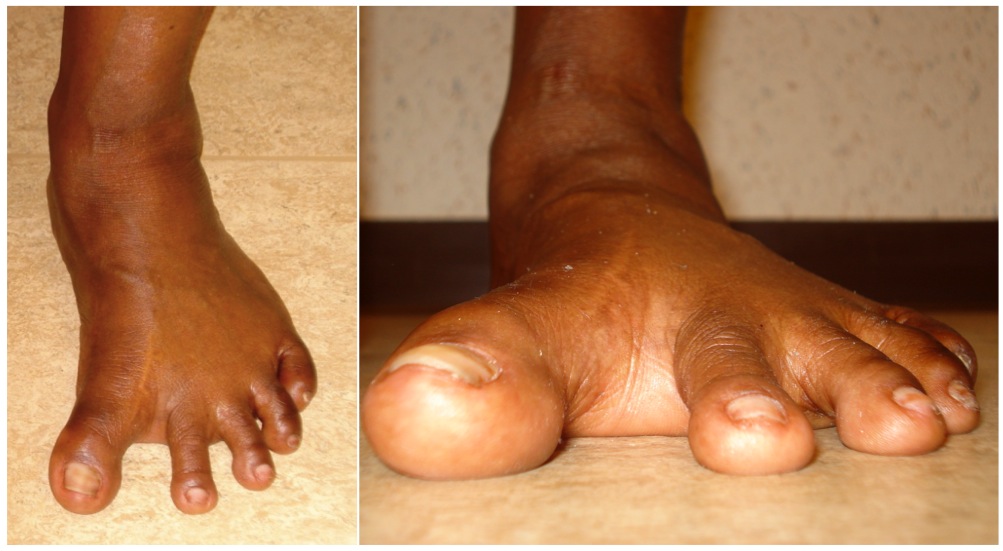
The term “hallux” refers to “big toe”. Once the big toe deviates from its straight axis, and points to the other foot more and more, we can speak of a “varus” deviation.
Causes
This varus position most often develops after a previous surgery for hallux valgus, usually due to an over-correction. Other known causes include trauma, certain systemic inflammatory diseases such as rheumatoid arthritis or psoriasis,…
Symptoms
At the beginning of the deviation, the joint can still be put back into the neutral position by you or the surgeon, maintaining mobility. After some time, however, a contraction occurs on the inside of the joint, with or without arthritis and hammer toe formation of the big toe.
Treatment
If you notice this varus position shortly after surgery for hallux valgus, a taping of the big toe toward the little toe for three months, can make the soft tissue heal sufficiently, to obtain a stable situation again, which does not require further surgery.
If this deformation does not really trouble you and if it is flexible, you can simply wear shoes with a wide tip, which don’t cause any friction. As the deformation of the toe increases and gets stiffer, wearing appropriate footwear will help less. In that case, surgery may be a remedy.
The first things to be checked are the mobility and flexibility of the metatarsophalangeal joint. If this is stiffened and painful, the best solution seems to be an arthrodesis.
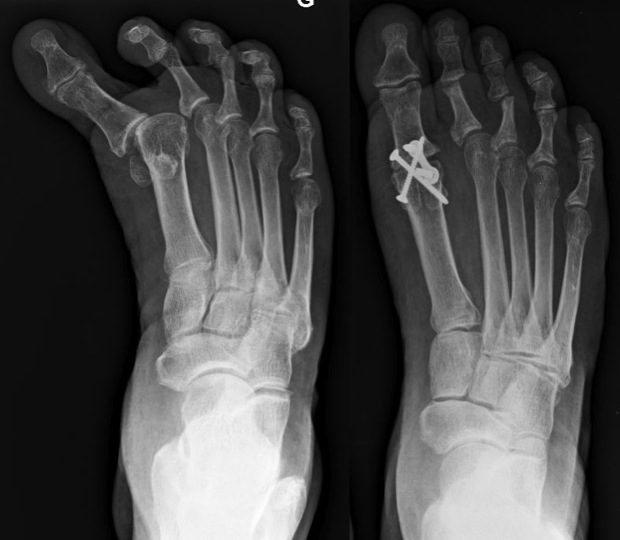
If this same joint remains movable and painless in de reduced, neutral position, various types of surgery can be proposed, taking into account other pathologies at the level of the big toe and the forefoot:
- The transfer of a tendon
- An osteotomy of the metatarsal or the phalanx.
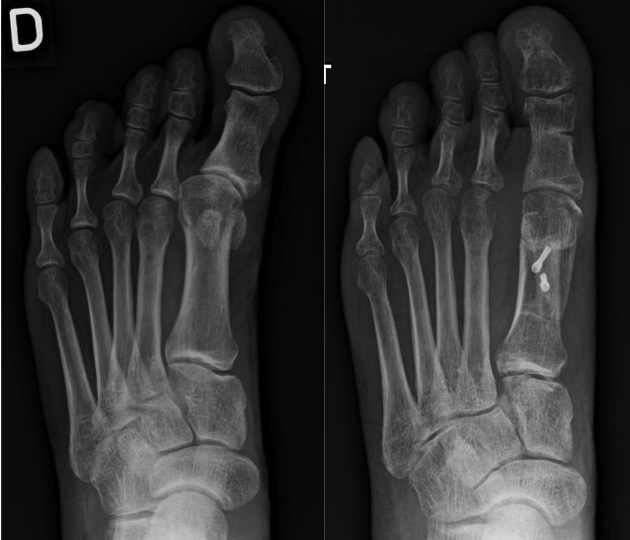
- An arthrodesis of the IP joint
- Reconstruction of the medial side of the metatarsal head
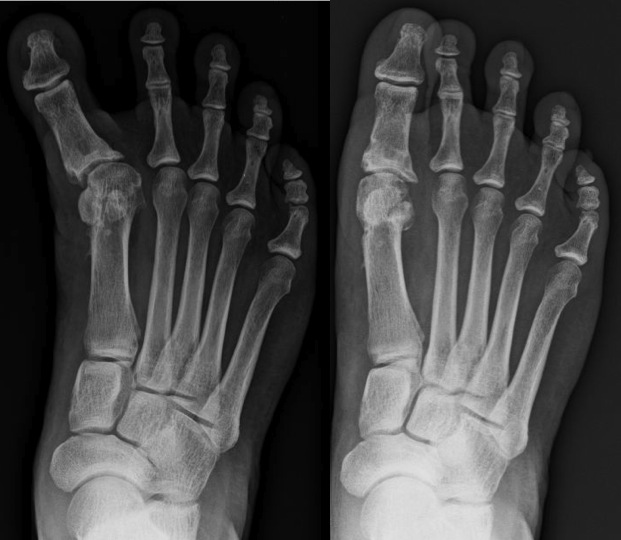
- Reconstruction of the ligament on the lateral side of the joint: for this, Prof. Leemrijse has developed his own technique to recover the balance around the joint, which is now widely used in much of the world.
Postoperative policy
Depending on the technique that was performed, the postoperative policy will only allow partial weight bearing in an adapted postoperative shoe for 6 weeks, need a high position of the lower leg for at least several weeks,…
For more information on the care, the disability, etc., please read the information leaflet concerning the pathology of the forefoot.