Bunionette or Tailor’s bunion
Definition
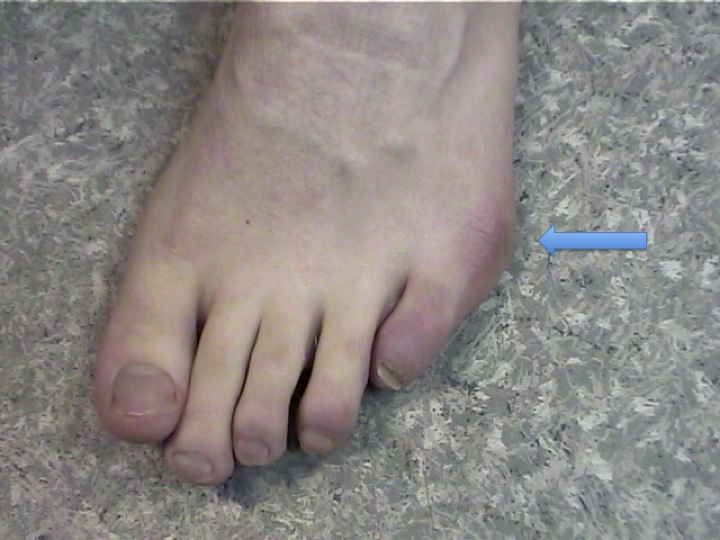
Due to friction and/or overpressure, on the outside of the fifth metatarsal joint, inflammation or callus arises.
Causes
This deviation was typical in cross-legged tailors who, at that time, created a continuous overpressure on the outside of the forefoot.
Treatment
If a conservative treatment, based on appropriate footwear and podiatric care doesn’t suffice, surgery may be proposed.
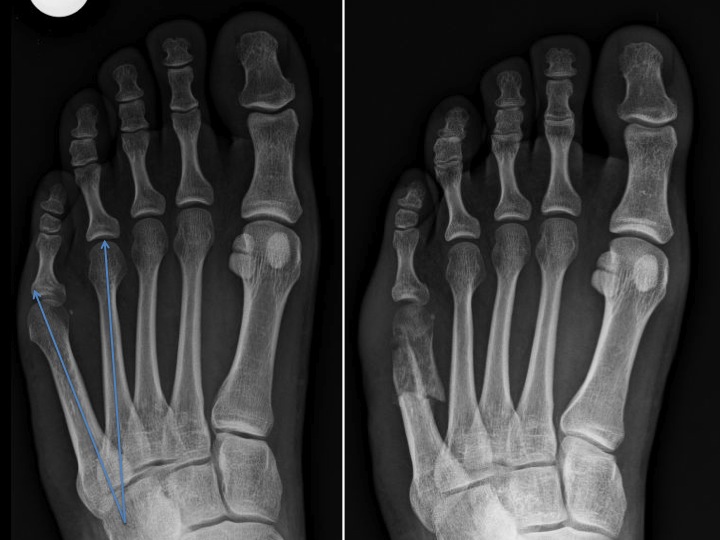
Depending on what type of bunionette at a standing X-ray is seen, a different type of osteotomy (open or percutaneous) will correct the deformity:
- Type 1: in 33% of the cases: the head of the fifth metatarsal is slightly too bulky and therefore should be reduced.
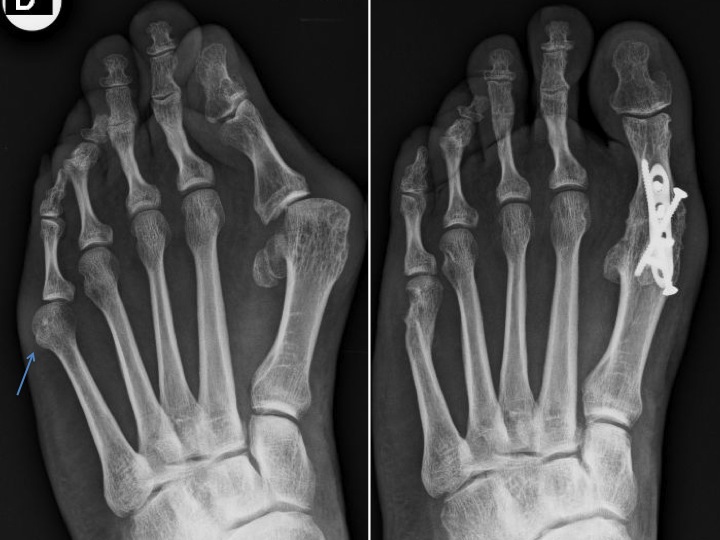
- Type 2: in 23% of the cases: the end of the fifth metatarsal has an increased curvature to the outside, which can be straightened through a distal osteotomy.
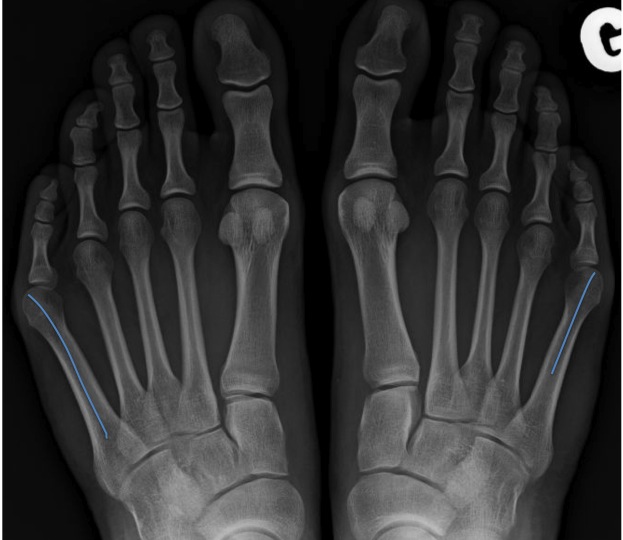
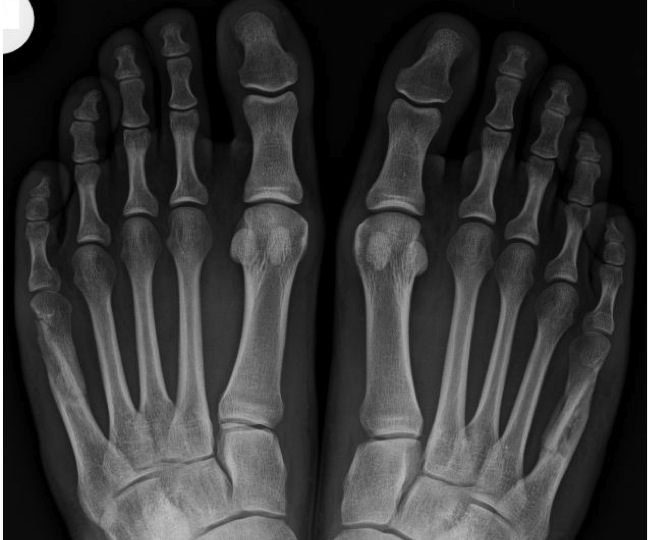
- Type 3: in 44% of the cases, we see that the angle between the 4th and the 5th metatarsal is enlarged. A proximal osteotomy or an osteotomy at the level of the deformity aims at reducing the angle to a normal value.
Postoperative policy
In most cases, this operation is performed as a one day surgery. We do ask to relieve the forefoot relatively for about four weeks after surgery by wearing a special surgical shoe.
For more information on the care, the disability, etc., … please read the information leaflet concerning the pathology of the forefoot.
This can be considered as the counterpart of a hallux valgus, but on the outside of the foot.
Symptoms
Due to friction and/or overpressure, on the outside of the fifth metatarsal joint, inflammation or callus arises.
Causes
This deviation was typical in cross-legged tailors who, at that time, created a continuous overpressure on the outside of the forefoot.
Treatment
If a conservative treatment, based on appropriate footwear and podiatric care doesn’t suffice, surgery may be proposed.
Depending on what type of bunionette at a standing X-ray is seen, a different type of osteotomy (open or percutaneous) will correct the deformity:
- Type 1: in 33% of the cases: the head of the fifth metatarsal is slightly too bulky and therefore should be reduced.
[/vc_column_text][/vc_column][/vc_row]
- Type 2: in 23% of the cases: the end of the fifth metatarsal has an increased curvature to the outside, which can be straightened through a distal osteotomy.
- Type 3: in 44% of the cases, we see that the angle between the 4th and the 5th metatarsal is enlarged. A proximal osteotomy or an osteotomy at the level of the deformity aims at reducing the angle to a normal value.
Postoperative policy
In most cases, this operation is performed as a one day surgery. We do ask to relieve the forefoot relatively for about four weeks after surgery by wearing a special surgical shoe.
For more information on the care, the disability, etc., … please read the information leaflet concerning the pathology of the forefoot.